How Kuwait's national ID was
issued at scale
Responsible for maintaining all information on population and civil event registrations (births, deaths, immigration) for Kuwaiti citizens and residents, The Public Authority for Civil Information (PACI) hold millions of civilian records in their central national database.
The deployment in numbers
Secure citizen digital identity for Kuwait's national identity scheme
PACI maintains Kuwait’s central civil register and the Civil Information System that draws on it. Moving citizens from paper identity documents to a secure smart card meant issuing multi-application JavaCards at national scale, with certificates and biometrics on each card, without disrupting the services that depend on the register.
PACI were issuing paper-based identification documents to citizens
The requirements went well beyond replacing a paper document. A single card had to hold multiple applications, multiple VeriSign certificates, fingerprint biometrics and several agencies' data with discrete protection for each, and qualify as an ICAO compliant travel document. A single system had to drive it all from PACI's existing central platform, personalise cards across a 40-printer farm, and support citizen collection and post-issuance updates at self-service kiosks.
Issuance of multi-application JavaCards
Issuance of multiple VeriSign certificates per card
Writing of fingerprint biometric data to cards
Driving a central printer farm of 40 printers in a secure PACI facility
MyID was implemented to act as a single management system for all PACI processing
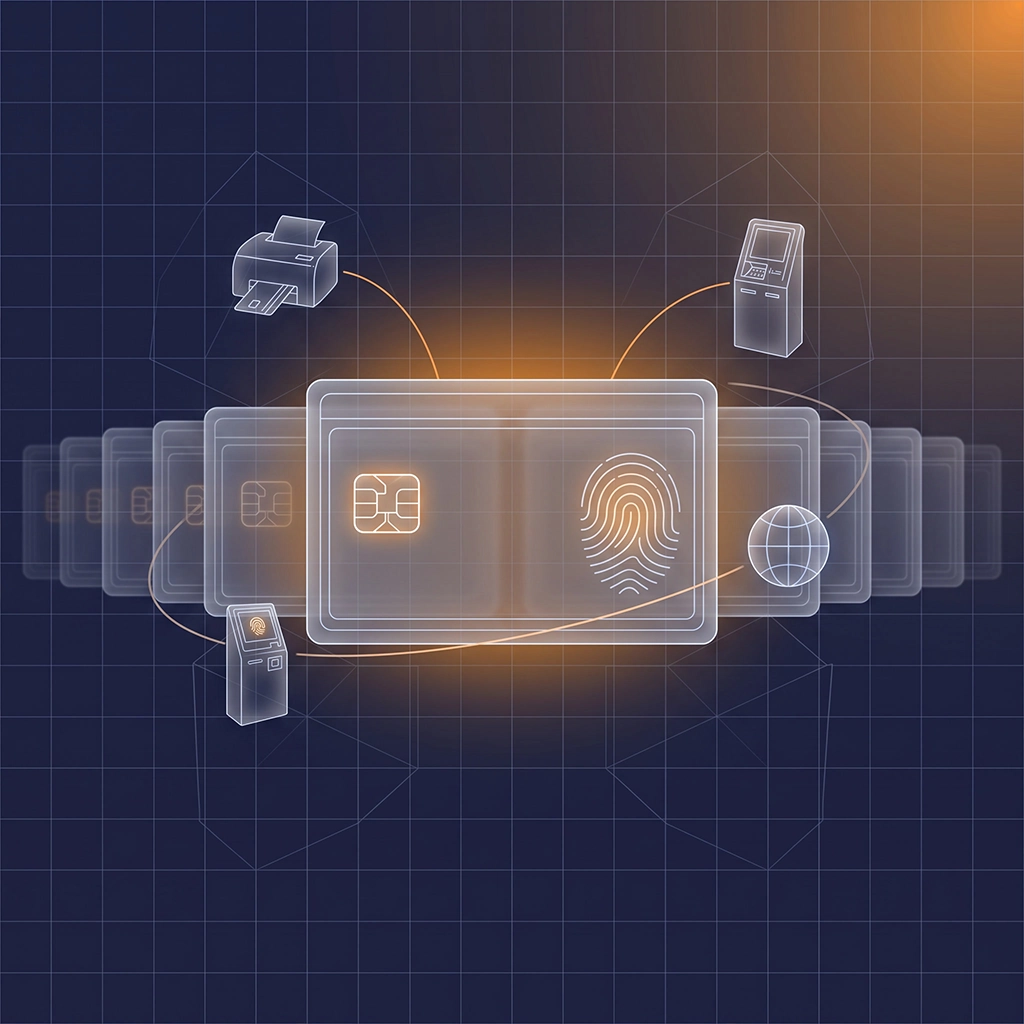
End user self-service national identity card operations. Instructions to personalise cards are passed to MyID via the MyID Lifecycle Management API from the central PACI system. MyID then automatically electronically and graphically personalises the cards by driving a farm of 40 printers in a secure PACI facility. For citizens MyID allows cards to be securely unlocked at the point of collection and for post-issuance activities such as adding certificates or updating data via a number of card update stations operating an end user version of MyID for citizen self-service.
Central instruction
personalisation instructions pass from the central PACI system to MyID through the MyID Lifecycle Management API.
Automated personalisation
MyID electronically and graphically personalises each card, driving a farm of 40 printers in a secure PACI facility.
Secure collection
citizens collect and unlock their cards at self-service points.
Post-issuance self-service
citizens add certificates and update data at card update stations running an end-user version of MyID.
Intercede has helped Kuwait build one of the most advanced and sophisticated national identity systems in the Gulf region. The selection of Intercede MyID credential management system enabled PACI to deliver a national identity card within time and budget to the citizens of Kuwait.
A national identity card delivered on time and on budget
The deployment delivered a centralised, audited identity solution aligned to the organisation's compliance, operational and user experience goals.
Delivered on time and on budget
MyID CMS enabled PACI to deliver the national identity card within time and budget.
One system, one process
back-office and citizen-facing operations run in a single product, combining electronic and graphical personalisation.
Built to scale
a load-balanced, multi-server deployment personalises cards across 40 printers for high-volume throughput.
A travel-ready credential
full ICAO compliance for use as an inter-country electronic travel document.
The platform behind the deployment
Intercede is a cybersecurity software company and the digital identity experts. For over 25 years, Intercede has helped government agencies, defence programmes, financial institutions and enterprises issue and manage high-assurance PKI credentials at scale, from national identity cards to smart cards, passkeys and mobile identities. MyID CMS integrates with an organisation’s existing certificate authorities, HSMs, printers and smart card manufacturers.
The MyID product family, MyID CMS, MyID MFA and MyID PSM, manages millions of credentials across more than 20 countries. Vendor-neutral architecture means MyID integrates with virtually any certificate authority, hardware security module or smart card manufacturer, without organisations replacing existing infrastructure.